How to know you are paying correctly for parking
Paying for parking should be one of the simplest tasks we perform in a day. You arrive, you park, you pay, and you move on.

In reality, things are not always so clear.
Recently, situations have emerged where drivers were redirected to fake payment pages after scanning QR codes that had no connection to the official parking system. For the user, the difference is almost impossible to notice at a glance.
And this is where the real question arises: how do you know you are paying correctly?
You don’t need to be an expert, but there are a few simple signs that can make a difference.
A first clue is the lack of clear operator identification. In a proper system, you know who manages the parking lot, and this is visible and consistent at all points of interaction.
Furthermore, the payment journey should be predictable. Whether we are talking about a terminal, an app, or an online page, the process should not “bounce” you through unknown links or interfaces that do not inspire confidence.
QR codes, in particular, are sensitive. If they are pasted over other materials, appear to be added later, or are not part of a clearly signaled layout, they deserve a moment of caution.

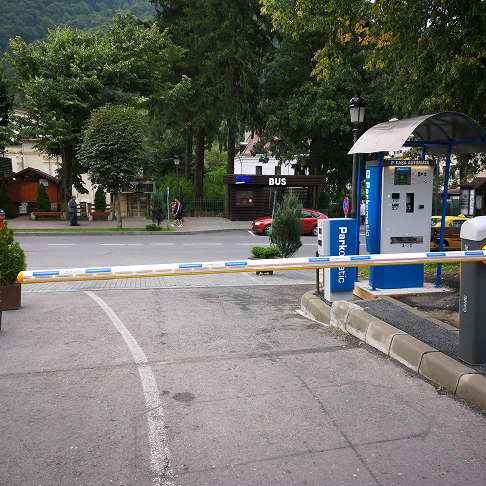
At the same time, it is important to say one simple thing: safety should not rely solely on the user’s vigilance.
In a well-designed parking lot, payment methods are integrated into the system, not added as an afterthought. There is clear control over all points of interaction, and the experience is consistent from entry to exit.
In practice, this means integrated systems, such as those developed by KADRA through Parkomatic, which centralize multiple payment options into a coherent flow. From cash or card payments at the terminal to contactless or mobile solutions, the experience remains the same, without variations or improvisations. In parking lots where electric vehicle charging stations are also present, integration allows for the management and payment of these services within the same system, without separate apps or processes.
Problems usually arise where solutions are fragmented or improvised. Where systems are not designed as a unit or where maintenance is not constant, gaps appear—and these are exactly the areas exploited in such situations.
Beyond technology, we are talking about responsibility.
A parking system is not just about barriers, terminals, or apps. It is about how all of these work together, are monitored, and are maintained over time.
For the user, paying for parking should remain a mundane task.
The moment it becomes a source of uncertainty, it is a sign that the system behind it needs more than just technology: it needs control, coherence, and responsibility.
Didn't find what you were looking for? Search below!