How hard does an automatic door work in a year?
One opening followed by one closing equals one operating cycle. For the user, it is an almost imperceptible action. For the door, each cycle means starting the operator, moving the drive system and door leaves, activating the sensors, stopping, reversing direction, and returning to the initial position.
At a rate of 1,000 cycles per day, a door reaches approximately 365,000 cycles in a year. This is only an example calculation: in a high-traffic building, the actual volume may be higher, while in other spaces it may be much lower. That is precisely why maintenance should not be planned solely by the calendar, without taking usage into account.
The question is not whether the equipment wears out, but whether the wear is identified during a planned inspection or after the door starts operating incorrectly.
What is working at every opening?
An automatic door brings together mechanical, electrical, and electronic components. Some support movement, others control it, and others continuously monitor the area around the door to protect users.
Depending on the type and configuration of the equipment, the following are subject to load:
- the operator and control unit;
- the drive belt, rollers, carriages, and guides;
- hinges, arms, or folding mechanisms, for other types of doors;
- activation and safety sensors;
- locking systems, batteries, and emergency functions;
- seals, profiles, and elements in contact with the floor or façade.
Wear does not occur the same way everywhere. Dust, humidity, temperature variations, drafts, accidental impacts, and traffic with carts or equipment can change the rate at which components lose adjustment or need replacement.


Maintenance does not mean only repairing a jammed door
Corrective service starts after a fault occurs. Preventive maintenance aims to identify play, misadjustments, wear, and unusual behavior early, before they lead to equipment downtime or affect other components.
A service inspection may include, depending on the door type and the manufacturer’s instructions:
- visual inspection and checking fasteners;
- cleaning and lubricating components where these operations are specified;
- checking and adjusting the drive system, rollers, guides, or arms;
- testing sensors and safety zones;
- checking locking systems, batteries, and operating modes;
- testing connections to the building’s access control or safety systems;
- documenting the equipment’s condition and recommending the necessary interventions.
The goal is not the preventive replacement of every part, but making decisions based on the equipment’s actual condition and the associated risk.
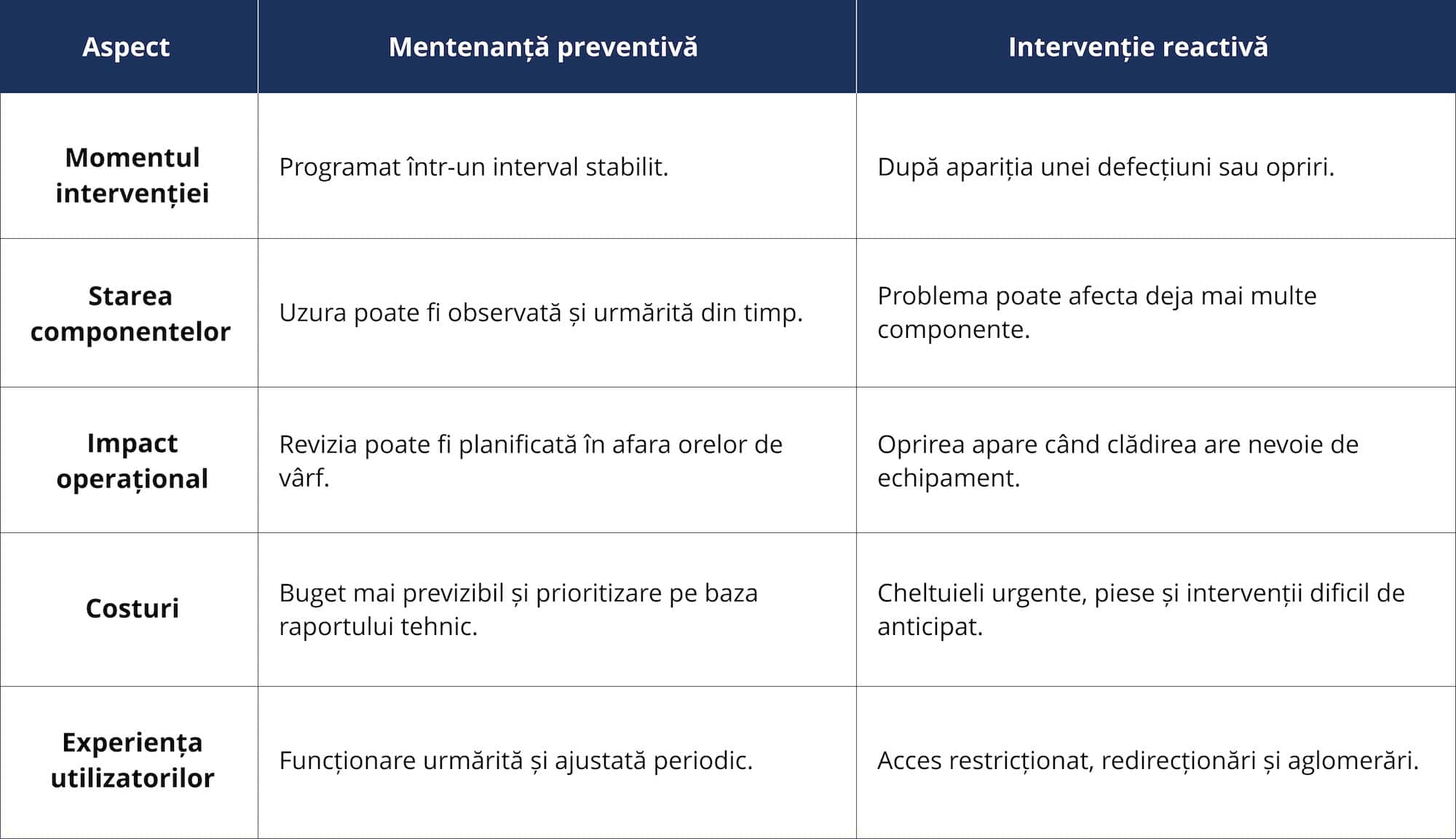
Preventive or reactive: the difference shows in building operations
What can happen when a small issue is ignored
A door that starts moving with more resistance can place additional load on the drive system and operator. A misadjusted sensor can cause stops or repeated re-openings. A dirty or damaged guide can affect the movement of the door leaf. A worn seal can influence airtightness and comfort in the access area.
These situations do not always lead to the door immediately jamming. That is precisely why they can be postponed. The equipment continues to operate, but increasingly outside the correct parameters, until the effect becomes visible and the intervention becomes more difficult.
Signals worth reporting
Building staff should not adjust the operator or safety systems, but they can quickly observe and report changes in behavior. Signals that warrant a technical inspection include:
- new noises, vibrations, or jerky movement;
- slower or incomplete opening, or differences between door leaves;
- closures followed by re-openings without an obvious reason;
- delayed response when a user approaches;
- intermittent operation or error messages;
- door leaves that are no longer correctly aligned;
- the door remains open or no longer maintains the selected operating mode;
- impacts, cracks, or visible damage to components and profiles.
If the door shows behavior that could put users at risk, the area must be secured and the equipment checked by qualified technical personnel. Improvised adjustments may temporarily hide the symptom without addressing the cause.
How often should maintenance be done?
There is no universal frequency suitable for all doors. The plan must be set based on the manufacturer’s recommendations, the equipment type, the number of cycles, the environment in which it operates, and the role of the access point in the building.
A secondary entrance used occasionally does not have the same duty cycle as the main access in a shopping center, an airport, or a hospital. For a critical door, the consequence of downtime is greater, and inspections must be scaled accordingly.
KADRA structures maintenance subscriptions with one, two, or four service inspections per year, plus different response times and benefits. Package selection should start from the equipment inventory and operational risk, not only from the number of included visits.
The cost of downtime is higher than the repair invoice
In an active building, a jammed door may require cordoning off the area, redirecting traffic flow, staff intervention, and additional communication with users. If it remains open, it can affect thermal comfort. If it is the only suitable access for certain users, it can also create an accessibility issue.
The total cost therefore includes not only the part and labor, but also downtime, disruption to activity, and effects on other systems or components.
Who uses the door?
A suitable solution for an adult without mobility difficulties is not automatically suitable for every user. Children, older people, wheelchair users, people with visual impairments, or those pushing carts have different speeds and trajectories.
Clear opening width, hold-open time, sensor and control placement, the visibility of glass door leaves, and floor continuity all matter. These elements relate to both accessibility and operational safety.
What a KADRA case study shows
In an analysis conducted for the 2019–2024 period, KADRA compared two operating scenarios: a portfolio maintained reactively and one with preventive maintenance from the outset. The calculated cost per door was approximately €3,161 in the reactive scenario and €1,287 in the preventive one.
The comparison does not mean that every building will achieve the same difference. It does, however, show the economic mechanism of maintenance: early detection and correction of wear can avoid more extensive interventions and make expenses easier to plan.
A good plan starts with the equipment’s actual condition
For doors already installed, the first step may be a technical audit. This provides an overview of the condition of operators, mechanical components, sensors, and integrations, and allows work to be prioritized: what must be remedied immediately, what can be planned, and what must be monitored at subsequent inspections.
For new equipment, the maintenance plan should be established from commissioning. This way, the intervention history starts with use, and adjustments and replacements can be tracked throughout the entire service life.
An automatic door has two important moments: the day it is chosen and all the days it must operate. Maintenance connects the two.
Do you have automatic doors in operation?
Didn't find what you were looking for? Search below!